
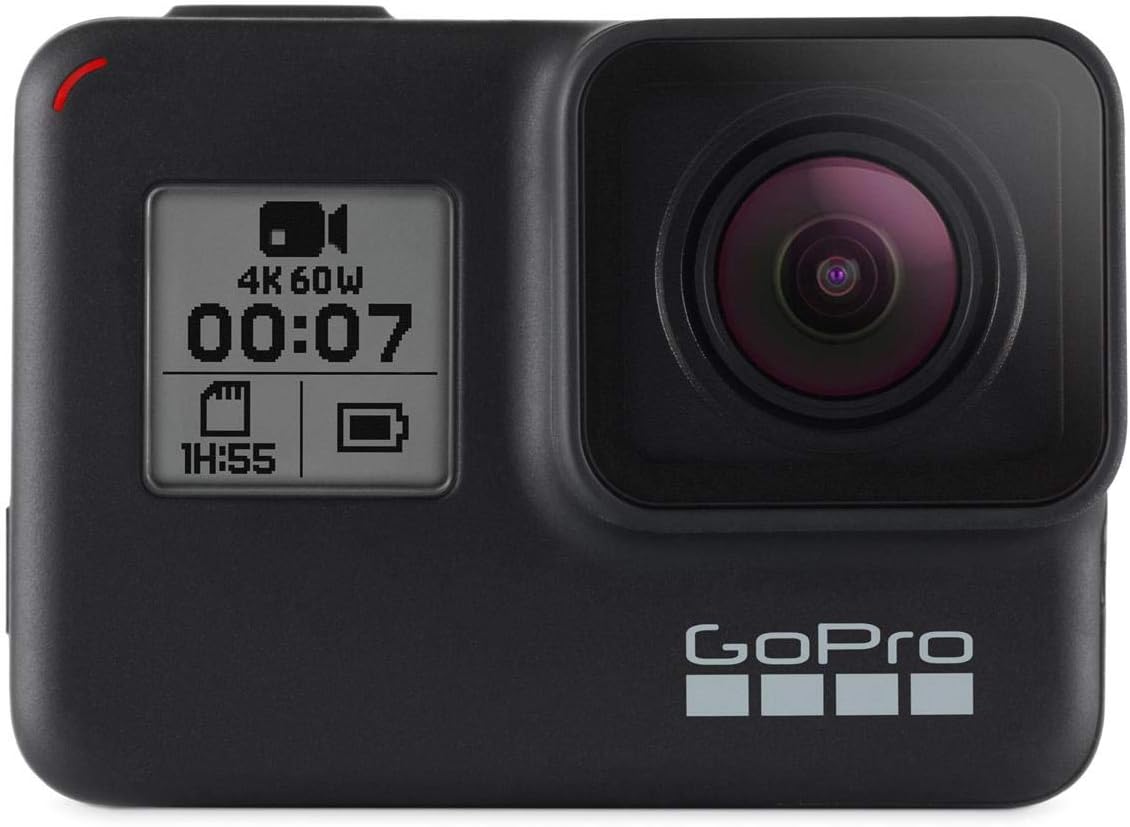
When GoPro released the Hero 7 Black in September 2018, it marked a pivotal moment in action camera evolution. This wasn’t just another incremental upgrade - the Hero 7 Black introduced HyperSmooth stabilization, the first electronic image stabilization system capable of delivering truly gimbal-like footage quality.
The Hero 7 Black remains highly sought after today, offering professional-grade features at an accessible price point for content creators and adventure enthusiasts who want proven performance without the premium cost of newer models.
 GoPro HERO7 Black Official Introduction
 GoPro Hero 7 Black: Features at a Glance
| Feature | Specification |
|---|---|
| Weight | 116 g |
| Dimensions | 62 mm x 45 mm x 33 mm |
| Video Capture Resolution | 4K @ 60 fps, 2.7K @ 120 fps, 1080p @ 240 fps |
| Photo Capture | 12 MP |
| Battery | 1220 mAh Li-ion (AABAT-001) |
| Waterproof | Up to 10 m (33 ft) |
| Stabilization | HyperSmooth |
| Other Features | TimeWarp, SuperPhoto, 720p Live Streaming |
Hero 7 Lineup Comparison: Black vs Silver vs White
The Hero 7 series marked GoPro’s return to offering multiple tiers, each targeting different user needs and budgets. Understanding these differences is crucial when considering the Hero 7 Black’s value proposition.
| Feature | Hero 7 Black ($399) | Hero 7 Silver ($299) | Hero 7 White ($199) |
|---|---|---|---|
| Max Video Resolution | 4K @ 60fps | 4K @ 30fps | 1080p @ 60fps |
| Photo Resolution | 12 MP | 10 MP | 10 MP |
| Stabilization | HyperSmooth | Basic Electronic | Basic Electronic |
| TimeWarp | ✓ | ✗ | ✗ |
| Live Streaming | 720p | ✗ | ✗ |
| Battery | Removable | Built-in | Built-in |
| Front Display | LCD Status Screen | ✗ | ✗ |
| ProTune Controls | ✓ | ✗ | ✗ |
| Karma Grip Compatible | ✓ | ✗ | ✗ |
| RAW Photo Support | ✓ | ✗ | ✗ |
The Hero 7 Black clearly stands apart as the only model offering the breakthrough HyperSmooth stabilization that defines this generation. The Silver and White models, while more affordable, sacrifice the key innovation that makes the Hero 7 series significant.
Performance and Key Features
GP1 Processor with Enhanced Memory
The Hero 7 Black utilizes GoPro’s custom GP1 processor paired with 1GB of RAM - double the memory of the Hero 6 Black. This additional processing power enables the advanced stabilization algorithms and real-time video processing that define the Hero 7 Black’s capabilities.
The increased memory capacity allows for more sophisticated computational photography and video features while maintaining smooth performance during intensive recording scenarios.
Video and Photo Capabilities of the GoPro Hero 7 Black
Supported Video Resolutions
| Resolution | Frame Rates | Max Bitrate |
|---|---|---|
| 4K (16:9) | 60, 30, 24 fps | 75 Mbps |
| 4K (4:3) | 30, 24 fps | 75 Mbps |
| 2.7K (16:9) | 120, 60, 30 fps | 75 Mbps |
| 2.7K (4:3) | 60, 30 fps | 75 Mbps |
| 1440p (4:3) | 120, 60, 30 fps | 60 Mbps |
| 1080p (16:9) | 240, 120, 60, 30, 24 fps | 60 Mbps |
Supported Photo Modes
| Mode | Resolution | Features |
|---|---|---|
| Standard Photo | 12 MP | Single shot |
| SuperPhoto | 12 MP | HDR, Local tone mapping |
| RAW Photo | 12 MP | Unprocessed format |
| Burst Photo | 12 MP | Up to 30 fps |
| Time Lapse Photo | 12 MP | Interval capture |
| Portrait Mode | 12 MP | Vertical orientation |
The Hero 7 Black delivers robust video performance with bitrates reaching 75 Mbps for 4K and 2.7K recording. While not quite matching the 100 Mbps capabilities of later models, this bitrate provides excellent detail retention and color accuracy for professional-quality footage.
The camera supports an impressive range of frame rates, including 1080p at 240fps for ultra-slow motion capture and 4K recording at up to 60fps. The addition of 2.7K at 120fps strikes an ideal balance between resolution and slow-motion capabilities.
HyperSmooth: The Stabilization Breakthrough That Changed Everything
HyperSmooth represents the defining feature of the Hero 7 Black and arguably the most significant advancement in action camera technology since waterproofing. This isn’t just an incremental improvement - it’s a fundamental shift that makes previously unusable footage consistently smooth and professional-looking.
The system leverages the Hero 7 Black’s additional 1GB of RAM to perform real-time predictive scene analysis, using accelerometer data, GPS information, and visual scene analysis to anticipate and counteract camera movement before it affects the footage.
- Gimbal-level results: Delivers stabilization quality that rivals mechanical gimbals in most scenarios
- 4K60 compatible: The first GoPro to stabilize 4K 60fps footage effectively
- Minimal crop factor: Retains approximately 90% of the original frame
- Real-time processing: No post-production work required - footage is smooth straight from the camera
- Activity-aware: Algorithms adapt based on detected movement patterns
 GoPro Hero 7 HyperSmooth vs Gimbal Comparison
 What makes HyperSmooth transformative is its ability to eliminate the handheld jitter and sudden jolts that previously required expensive gimbal systems to manage. Whether you’re mountain biking down rocky trails, running, or even just walking, the Hero 7 Black delivers footage that looks professionally stabilized.
The technology essentially “floats” the video frame within the sensor’s field of view, using the extra margin to compensate for camera shake. This approach means that activities previously requiring careful gimbal setup can now be captured with simple handheld operation while maintaining cinematic smoothness.
For content creators, this represents a paradigm shift - eliminating the need to carry additional stabilization equipment while dramatically improving the usability of action footage in final edits.
Field of View Options
The Hero 7 Black offers three distinct field of view settings to match different shooting scenarios:
- SuperView: Ultra-wide 155° field of view for immersive action footage
- Wide: 118° standard GoPro perspective for balanced composition
- Linear: Corrected view with reduced distortion for more natural-looking footage
Innovative Features
TimeWarp: This hyperlapse feature automatically stabilizes time-lapse footage while you move through a scene. The result is smooth, professional-looking time-lapse video that would traditionally require expensive equipment and post-production work.
SuperPhoto: An intelligent mode that automatically applies HDR, local tone mapping, or noise reduction based on the scene. The camera analyzes lighting conditions and applies the most appropriate processing for optimal image quality.
Live Streaming: Stream directly to social media platforms in 720p resolution while simultaneously recording higher-quality footage to the SD card for later use.
Portrait Mode: Capture vertical video and photos optimized for social media sharing, with the interface automatically rotating to match orientation.
Design and Build Quality
The Hero 7 Black maintains the classic GoPro form factor that users have come to appreciate. Measuring 62mm x 45mm x 33mm and weighing 116g, it’s compact enough for any mounting scenario while feeling substantial and durable.
Unlike later models, the Hero 7 Black requires a separate protective cage for mounting to accessories. While this adds a step to the setup process, it also provides excellent protection for the camera body and lens during extreme activities.
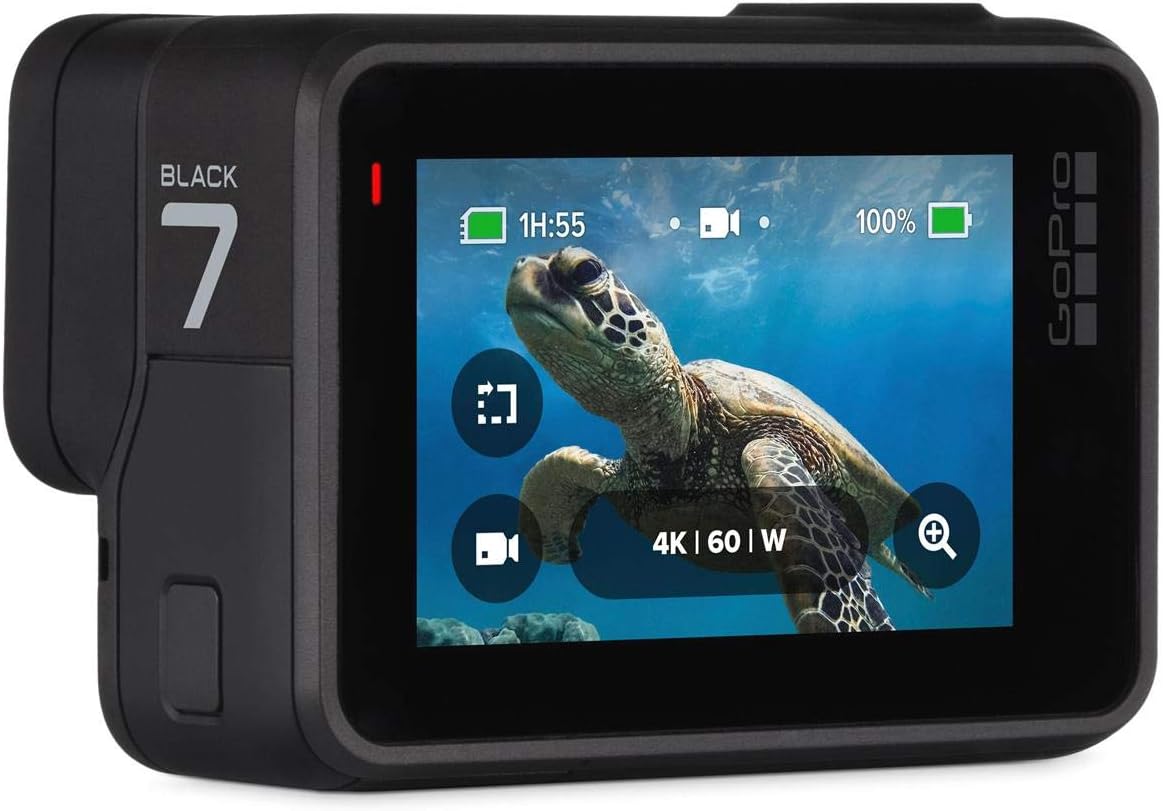
The dual-screen design features a 2-inch color touchscreen on the rear and a smaller status display on the front, making it easy to frame shots and monitor recording status during self-recording scenarios.
Battery Performance and Thermal Management
The Hero 7 Black uses the same 1220 mAh lithium-ion battery (AABAT-001) as the Hero 5 and Hero 6, ensuring compatibility with existing accessories. However, the increased processing demands of HyperSmooth and other advanced features can impact battery life during intensive use.
Real-world testing shows approximately 90 minutes of 4K60 recording per battery, though this varies significantly based on features used, ambient temperature, and recording patterns.
The camera can experience thermal limitations during extended high-resolution recording, particularly when using HyperSmooth stabilization in warm environments. Breaking recordings into shorter segments helps maintain optimal performance.
User Experience and Interface
The Hero 7 Black introduced a completely redesigned user interface that emphasizes simplicity and smartphone-like navigation. The touch-based menu system allows quick access to essential settings without diving through complex menu structures.
Key Interface Improvements:
- Simplified mode switching with large, clear icons
- Customizable shortcut buttons for frequently used settings
- Gesture-based controls for quick camera operation
- Enhanced responsiveness compared to previous generations
Voice Control: The camera responds to 16 voice commands in multiple languages, enabling hands-free operation during activities where manual control isn’t practical.
Connectivity:
- 720p live streaming to Facebook and other platforms
- Wi-Fi and Bluetooth for smartphone connectivity
- USB-C for charging and high-speed data transfer
Computational Photography Advances
The Hero 7 Black’s increased processing power enables several computational photography features that enhance image quality beyond what the hardware alone could achieve.
SuperPhoto intelligently analyzes each scene and applies appropriate processing techniques. In high-contrast situations, it automatically enables HDR capture. For low-light scenes, it applies noise reduction algorithms. The local tone mapping feature helps balance exposure across the entire frame.
This intelligent processing approach means users can focus on capturing the moment rather than manually adjusting camera settings for each scenario.
Conclusion
The GoPro Hero 7 Black represents a watershed moment in action camera development. While previous generations focused on incremental improvements to resolution and features, the Hero 7 Black fundamentally solved the usability problem that had plagued action cameras since their inception - shaky, unusable footage.
HyperSmooth stabilization didn’t just improve video quality; it transformed the entire action camera use case. For the first time, creators could capture professional-grade footage without additional equipment, complex setups, or extensive post-production work. This single innovation made action cameras accessible to mainstream content creators and elevated the medium from novelty device to serious creative tool.
The Hero 7 Black’s impact extends beyond its technical specifications. By proving that advanced computational photography could deliver results comparable to expensive mechanical systems, it established the technological foundation that continues to define modern action cameras across all manufacturers.
While the Silver and White models offered budget alternatives, they missed the point entirely by excluding HyperSmooth. The stabilization breakthrough was the Hero 7’s defining achievement, making the Black model the only version that truly delivered on the generation’s promise.
For current buyers, the Hero 7 Black remains remarkably relevant. Its core stabilization capabilities, 4K60 recording, and intuitive operation provide everything needed for professional-quality content creation. While newer models offer incremental improvements, the Hero 7 Black established performance benchmarks that continue to satisfy most real-world requirements.
Whether capturing outdoor adventures, family moments, or social media content, the Hero 7 Black offers the reliability and image quality that turned action cameras from specialized tools into essential creative devices. Its legacy lies not just in what it accomplished, but in proving that thoughtful software innovation could be just as transformative as hardware advancement.
This article may contain affiliate links to Amazon, eBay and other retailers. I may earn a small commission from qualifying purchases made through these links at no additional cost to you.